The AI Readiness Canvas
A structured framework to assess and plan your organisation's journey toward AI. Identify gaps, align resources, and plot a clear path — from vision to measurable outcomes.
Contents
Introducing the AI Readiness Canvas
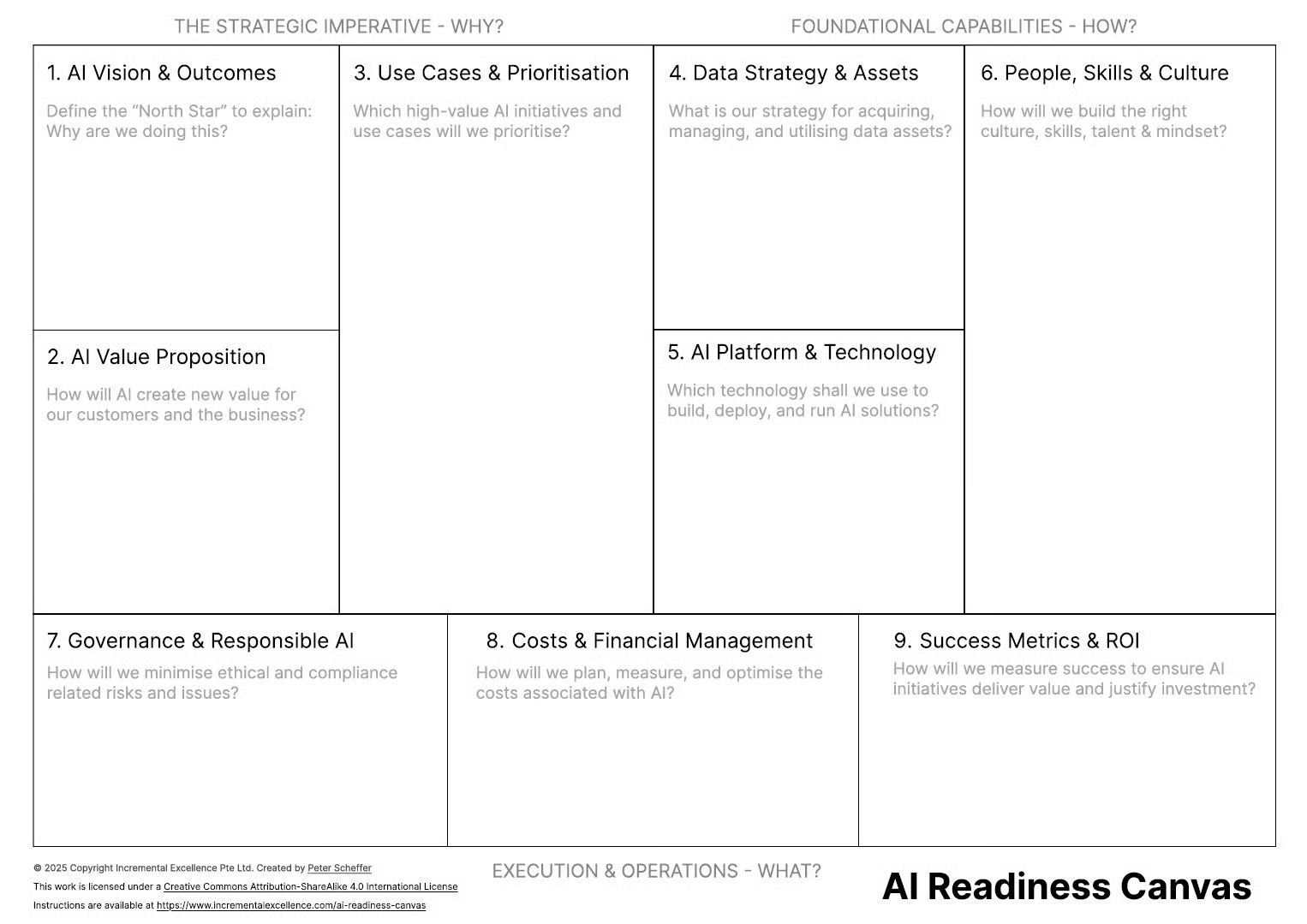
The AI Readiness Canvas helps organisations develop AI strategy by highlighting gaps, drivers, and purpose. Designed as an iterable template — similar to the Business Model Canvas — it allows teams to explore multiple options before finalising their approach.
Published: October 2, 2025
Why?
The Strategic Imperative
Focuses on business vision and value proposition, working backward from desired outcomes. Covers Sections 1, 2, and 3.
How?
The Foundational Capabilities
The resources, skills, and culture required. Addresses data, technology, and people capabilities. Covers Sections 4, 5, and 6.
What?
The Execution & Operations
Describes implementation including governance, costs, and success metrics. Covers Sections 7, 8, and 9.
AI Vision & Business Outcomes
Purpose: Define the "north-star" for AI adoption tied to tangible business impact.
Key Questions
- check_circleWhat are primary business objectives — cost reduction, revenue growth, new products, customer experience, efficiency?
- check_circleWhat's the long-term vision for an AI-driven organisation?
- check_circleHow does AI create competitive advantage or address market shifts?
- check_circleWhat transformational opportunities can AI unlock — new business models, new markets?
AI Value Proposition
Purpose: Focus on how AI creates new value for customers and the business.
Key Questions
- check_circleWhat compelling new products, services, or features can incorporate AI?
- check_circleHow can AI create hyper-personalised experiences at scale?
- check_circleHow will AI uniquely solve customer problems or fulfil needs?
- check_circleHow can differentiation improve through value creation?
Key Use Cases & Prioritisation
Purpose: Identify and prioritise high-value, feasible AI initiatives.
Key Questions
- check_circleWhat are the top 3–5 business problems to solve with AI now?
- check_circleHow will use cases be prioritised by impact, feasibility, and time-to-value?
- check_circleWhich use cases offer quick wins versus long-term strategic bets?
Common Industry Use Cases
Data Strategy & Assets
Purpose: Data is "the genesis of invention" for AI. Focus on acquiring, managing, and leveraging data as a core business asset.
Data quality, accessibility, and governance must be addressed before AI can deliver reliable value.
Key Questions
- check_circleWhat internal and external data sources are needed for prioritised use cases?
- check_circleWhat's required to make our data usable — cleaning, labelling, enrichment?
- check_circleHow will data quality, accessibility, and governance be ensured — data lakes, APIs, catalogues, ownership?
- check_circleHow will an "AI flywheel" be built where products generate new data that improves AI?
AI Platform & Technology Stack
Purpose: Define a scalable, enterprise-grade technology platform for building, deploying, and operating AI solutions.
Key Questions
- check_circleWhat will the AI technology stack include — cloud services, data hosting, hardware, vendor solutions?
- check_circleWhat's the Build vs. Buy vs. Partner strategy?
- check_circleHow will the AI lifecycle be managed — from experimentation to production?
- check_circleWill the approach be centralised, hybrid, or decentralised?
People, Skills & Culture
Purpose: Address talent, upskilling, and the cultural mindset necessary for successful adoption.
Key Questions
- check_circleWhat AI talent and roles need hiring, training, or outsourcing — data scientists, ML engineers, AI strategists?
- check_circleHow will an AI-ready culture be fostered — embracing experimentation, collaboration, and data-driven decisions?
- check_circleWhat's the strategy for creating AI Fluency — a shared language between business and tech teams?
- check_circleHow will change and employee concerns be managed throughout the transition?
Governance & Responsible AI
Purpose: Orchestrate AI initiatives while minimising risks and ensuring ethical use. A board-level concern.
Responsible AI frameworks must address fairness, transparency, accountability, and privacy by design.
Key Questions
- check_circleWho is accountable for AI governance and ethical oversight?
- check_circleWhat Responsible AI framework is in place — fairness, transparency, accountability, privacy?
- check_circleHow will AI-specific risks be managed — data privacy, model bias, hallucinations, cybersecurity threats?
- check_circleHow will compliance with emerging regulations like the EU AI Act be ensured?
Cost Structure & Financial Management
Purpose: Plan, measure, and optimise costs associated with AI — which often follow different patterns than traditional IT.
Key Questions
- check_circleWhat are the key cost drivers — compute, data storage, talent, model licensing?
- check_circleHow will compute costs be managed and optimised over time?
- check_circleWhat's the FinOps strategy for AI to manage cloud costs effectively?
- check_circleHow will Total Cost of Ownership (TCO) be estimated and tracked?
Success Metrics & ROI
Purpose: Define and measure success, ensuring AI delivers tangible value across efficiency, effectiveness, and user experience.
Key Questions
- check_circleWhat Key Performance Indicators (KPIs) link directly to business outcomes?
- check_circleHow will financial ROI and non-financial benefits be measured?
- check_circleWhat process tracks value delivered by AI models post-deployment?
- check_circleHow will success be defined across efficiency, effectiveness, and user experience dimensions?
The 6 Perspectives
A comprehensive lens for evaluating AI readiness across the full organisation — from the boardroom to operations.
Business
Ensures AI investments drive digital transformation and strategic objectives. Positions AI as a central priority while mitigating risks and amplifying customer value.
CEO · CFO · COO · CIO · CTO
People
Acts as the connection between AI technology and operations. Focuses on talent, communication, and the organisational culture needed to stay competitive.
CHRO · CIO · COO · CTO · Cross-functional leaders
Governance
Enables coordination of AI programmes while optimising advantages and minimising transformation risks. Emphasises ethical AI application and evolving risk characteristics.
Chief Transformation Officer · CIO · CTO · CFO · CDO · CRO
Platform
Enables building enterprise-level, scalable cloud infrastructure for AI-enhanced services and products. Highlights how AI creation differs from conventional development.
CTO · ML Ops Engineers · Data Scientists
Security
Maintains confidentiality, integrity, and availability of information and cloud operations. Evaluates threat vectors impacting AI systems and mitigation strategies.
CISO · Compliance · Security Architects
Operations
Ensures cloud services, particularly AI operations, meet organisational requirements. Provides guidance on oversight, maintenance, and consistent value generation.
Infrastructure Leaders · ML Ops · SREs · IT Service Managers
6 Organisation Capabilities Enhanced by AI
AI doesn't just automate tasks — it fundamentally enhances how organisations strategise, create products, generate insights, and innovate.
Strategy Management
"Create new business value through application of Artificial Intelligence and Machine Learning."
ML facilitates innovative value propositions driving enhanced results: minimised risk, increased revenue, operational effectiveness, and strengthened ESG. Implementation must be grounded in concrete short-term or ambitious long-term business value.
Key Approach
- →Start with current business and customer challenges
- →Evaluate data flywheel characteristics — additional data generates enhanced systems expanding customer base
- →Assess if obtained data creates defensive barriers (scarce, expensive)
- →Determine whether to build, customise, or implement existing AI systems
Product Management
"Manage data-driven and AI infused or enabled products."
AI-based product development differs from traditional software. Begin with anticipated customer value gain and align measurable proxies to decision points AI can support.
Critical Elements
- →ML solutions impose data requirements (4 V's of Data)
- →Business, data, executive, and ML stakeholders must assess solutions together
- →Evolve through proper lifecycle management — consider how users interact with probability-based output
- →Build AI product management capability through experimental, time-bound approaches
Business Insights
"The power of AI to answer ambiguous questions or predict from past data."
Beyond descriptive and diagnostic analytics, ML enables predictive and prescriptive capabilities. AI augments subject matter experts by identifying root causes and modelling "what-if" scenarios — making data the catalyst for predictive decision-making.
Transition Approach
- →Use algorithms with diagnostic analytics to understand key variables influencing problems
- →Create an analytics centre of excellence tied closely to cloud initiatives
- →Democratise access to predictions and analysis across the organisation
- →Create a rhythm of using AI to inform major business decisions
Portfolio Management
"Identify and prioritise high-value AI products and initiatives that are feasible."
The challenge is demonstrating short-term results without compromising long-term value. Worst case: technical POCs that never progress because they focus on irrelevant technicalities rather than business outcomes.
Strategy
- →Start with small wins generating organisational confidence
- →Design a hierarchical portfolio where lower layers support upper layers — certain AI capabilities build upon each other
- →Embed AI flywheel design where portfolio value propels business outcomes enabling additional data benefits
- →Decide what to buy versus build — explore existing market solutions and their maturity levels
Innovation Management
"Question long-standing market hypotheses and innovate your current business."
ML offers disruptive capabilities across sectors. Connect mid- and long-term AI research objectives with short-term, applicable value propositions.
Approach
- →Explore evolving customer expectations from internal and external perspectives
- →Consider value chain differentiation: cost reduction, revenue/profit gains, or new income channels
- →Establish a grassroots movement through internal AI champions
- →Maintain balance between audacious and achievable goals
Generative AI
"Use the general-purpose capabilities of large AI models."
Generative AI, driven by Foundation Models pre-trained on extensive data, can generate new content — conversations, stories, images, videos, music. Primary promise: FMs generalise across domains and tasks, substantially decreasing knowledge work expense.
Strategic Decisions
- →Assess whether to develop FMs from the ground up, refine pre-trained models, or deploy existing vendor products
- →Extract genuine value by contextualising with domain-specific data across the task spectrum
- →Performance depends predominantly on data strategy and the data flywheel
- →Implement guardrails around generative AI systems, considering confidence in the data utilised
Ready to benchmark your AI readiness?
Join organisations using the AI Readiness Canvas to navigate digital transformation with strategic precision. Book a consultation with Peter Scheffer today.
Book a Consultation